So, I started building
August 19, 2026
In my last post, I wrote about how I want to do more, build more and try new things. But there’s really no way to figure that out except to actually build stuff and see where it leads. I don’t really know where any of this will lead, but I figured actually trying things is probably a better way to find out than continuing to think about them.
I have been doing that for the past few weeks and months and have actually created and put out two small projects: Inburgerpas NL and Ordinly.co.
Inburgerpas NL
Whenever you ask an LLM or watch a YouTube video about finding projects to build, one piece of advice always comes up: build a solution around a problem you face in day-to-day life.
Honestly, for a long time, I didn’t understand it. I could look around and not find anything that wasn’t already solved, so I was always like, what the fuck does this advice even mean?
And even more honestly, I still haven’t figured it out fully. But I feel like part of the reason is that I haven’t exposed myself to situations that force me to think about problems and the solutions around them.
Inburgerpas NL however is my first attempt at solving a problem I faced myself and building something that could hopefully help others in the same situation.
It’s a platform for people living in the Netherlands who are trying to pass the Dutch civic integration exams for permanent residency or citizenship. If you’re like me and have been living here on an HSM visa, you need to spend five years here and pass the A2-level integration exams to apply for Dutch PR.
Learning the language and preparing specifically for these exams is something most expats have to go through, and it can be quite challenging. I went through the process myself and felt there was a gap in the market.
My hypothesis, both generally and for these exams, is that you need to attempt them enough times until the process starts to feel natural. You start seeing patterns in the language and the tests: the most common vocabulary, grammar structures, and little tips and tricks that come up again and again.
After enough repetition, passing the exam starts to feel almost trivial.
I couldn’t find a platform where you could do this for the Dutch integration exams, at least not without paying a good amount in monthly subscription fees. So I created one myself.
The idea is simple: you can practice for writing, reading, listening, and other exams. There are enough questions to repeat the process over and over, you get feedback based on your attempts, and you can track your progress.
Hopefully, after going through this for a few days, you feel much more confident than you would have otherwise.
This is the first project I’ve built myself and actually put out there. It has already generated a few organic users, with around 1500 questions answered by 10 different users.
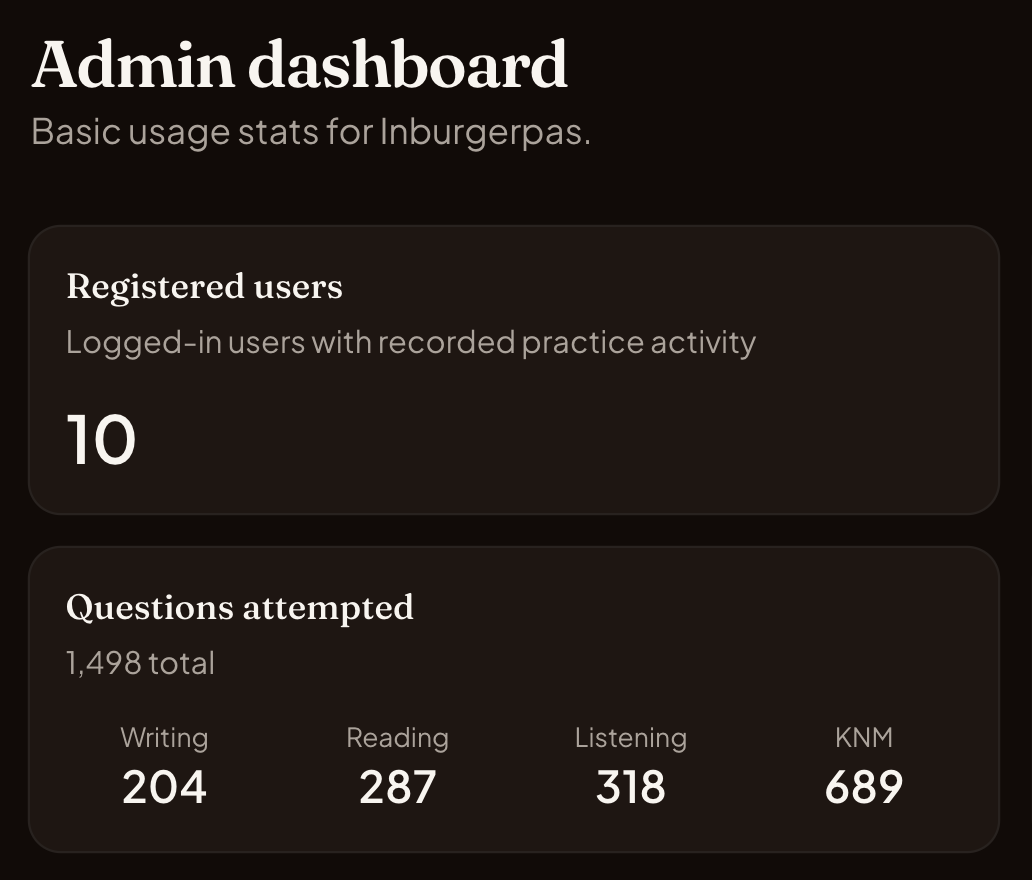
Of course, it’s not much, but it still makes me so happy to see that actual people are using something I built and hopefully getting value from it.
Learnings from Inburgerpas
Building the platform was fairly straightforward thanks to AI, but I made sure I didn’t just vibe code it. I tried to design it properly so it wouldn’t turn into AI slop.
The harder part now is figuring out whether users actually find it useful.
Which features should be available to everyone, and which ones should require signing in? How do I make sure the questions are up to the right standard for the civic integration exams? And, most importantly, how do I market this so it reaches more people?
I haven’t figured any of this out yet, and honestly, it’s more challenging than you would think.
As software becomes a cheaper commodity, understanding your users, knowing what features to build and what not to build, getting feedback, and making sure your product actually provides value becomes even more important.
Ordinly
This project simply came out of a nice, fun discussion with friends. The idea is simple: you go to a restaurant and scan a QR code to see the menu, but what if you could actually talk to the menu through text or voice and in your preferred language? Ask questions, clarify allergies, get recommendations, and more. Sounds fun? At least, it did to me, so I built Ordinly.
The long-term vision is to have this become a full-on solution for small to medium-sized restaurants to help them manage their menus, orders, payments, and reviews, all in one platform backed by intelligence. Imagine a customer comes in, scans the QR code, interacts with the menu through chat, places an order, pays for it, and eventually leaves a review for the food and service, all from the same place. That’s the vision, or at least that’s how it started.
Currently, it is live. Restaurants can sign up, import their menus from PDFs or a website link, generate their QR code, and get going. They can also manage orders from the platform, with a dashboard showing incoming orders in real time. Payment integration and voice support in the chat are next in line.
What I like most about this project is that it actually works. Whenever my friends and I visit a new restaurant, we simply sign it up, give it the restaurant’s website or a picture of the menu, and within a minute or two, we are already talking to the menu and testing it live. And so far, it has worked pretty well out of the box. If restaurant owners could refine the menu a little, add more pictures, and fill in things like allergy information and other details, I feel like this could really be something.
Learnings from Ordinly
The biggest learning from this project is: don’t build something without actually talking to some potential customers first. AI has made it so easy to build software that you can discuss a fun idea with your friends and, by the end of the weekend, have it live and working. But the real question is, who is going to use it? Do restaurants even care about this? And if they do, their existing POS (Point of Sale) software is probably much better placed to implement something like this.
How do you penetrate an existing market when you don’t even have a single customer willing to try what you’ve built? I have reached out to a few restaurants, but honestly, not a single one has replied. And all I’m asking is for them to join the pilot and have it running in their restaurant for a few weeks, completely free of cost. It has been complete silence so far. And that is probably the single most important learning from this project.
As I said in my previous learning from Inburgerpas, software is becoming a commodity. Knowing your customers, understanding their pain points, and then being able to come up with solutions for them is becoming much more important. If you don’t put yourself in places where you’re actually talking to different kinds of people, listening to them, and understanding their problems, how are you supposed to know what is actually worth solving? And if you’re just building stuff based on conversations with ChatGPT or your friend group, it’s like shooting an arrow into the sky. It may still hit something, but the probability is pretty low.
Conclusion
I am happy that I am building stuff and putting it out there in public. One of these projects has already seen some real users, so I am happy that I have at least started doing what I said I wanted to do.
At the same time, I am trying to get better at identifying real pain points, talking to people, understanding what they actually need, and then building things that are useful and bring real value. I still haven’t figured that part out, but I guess that’s what I need to work on next.
I am always open to feedback and tips that you feel would help me in this regards.